You lie down tired after a long day, but sleep just won’t come? Instead, your thoughts circle around the past day or the challenges of tomorrow and won’t let you relax. Before you start the next day overtired and exhausted, try relaxation exercises. These simple techniques can already help you fall asleep. Sometimes even a change in the sleep environment or evening habits helps.
It’s important that you don’t put pressure on yourself. Our body can handle a night of particularly poor sleep. Talking about sleep disorders too early can also be risky – here you can find out under what conditions you can assume a sleep disorder. Therefore, you don’t have to reach for medication right away. Maybe one of the following three relaxation exercises can already help you:
Autogenic Training
In autogenic training, you focus on your body and thereby block out worries and stress. Through the power of thought, certain areas feel warm, heavy, and relaxed. At first, concentrate fully on your breathing. In the next step, go through individual body parts and mentally repeat short phrases to yourself. For example, “My feet are getting very heavy”, “My arms are completely relaxed.” Start with your hands and feet, then move up through the forearms to the head.
With this relaxation exercise for falling asleep, your breathing rate slows down, your muscles relax, and your heartbeat slows. This leads to you falling asleep faster. Don’t worry if it doesn’t work right away – this relaxation technique takes some practice.
Progressive Muscle Relaxation according to Jacobson
Relaxation exercises like these counteract stress-related tension from everyday life by having you actively tense all your muscles and then consciously relax them. For this, lie comfortably in bed or sit on a chair and tense the muscles of one body part at a time, then release them again. Also start with a hand or a foot, tense the muscles for a few seconds, and then relax them. Continue this way through the arms, legs, shoulders, and other areas until everything is completely relaxed.
The tension should last between 5 - 10 seconds, and the relaxation phase about 30 - 40 seconds. With practice, you can actively perceive and feel muscle relaxation, and blood circulation is improved through targeted tensing. Take about 30 minutes before bedtime for the relaxation exercises.
Military Method
Have you ever heard of this American relaxation technique? It actually promises that you can fall asleep in 2 minutes or less. This routine was developed in America to help US Navy pilots fall asleep faster. Soldiers often have trouble sleeping due to anxiety, pressure, or background gunfire, but sufficient sleep is especially important for pilots. The basics of the Military Method are based, like autogenic training, on breathing and muscle relaxation:
First, relax your entire face. Then drop your shoulders to release more tension, and place your hands beside your body. Then exhale calmly and relax your chest.
Then relax your feet, thighs, and calves. To clear your mind, imagine a relaxing scene for 10 seconds. For example, lying by the sea watching the waves. If that doesn’t work, try repeating the words “don’t think” for 10 seconds. After these 10 seconds, you should fall asleep.
4-7-8 Breathing Technique
This breathing technique combines the powers of meditation with visualization and becomes more effective with practice. To prepare, place the tip of your tongue on the palate behind the two front teeth. Keep the tongue fixed there the entire time while pursing your lips.
First, close your lips and inhale through your nose.
Mentally count to 4. Then hold your breath for 7 seconds. After that, exhale through your mouth for 8 seconds with a hissing sound.
By focusing on counting and breathing, you can manage to be thoughtless. It is best to perform this technique for four full breaths. A pleasant state of relaxation should arise and your mind should calm down.
Yoga session
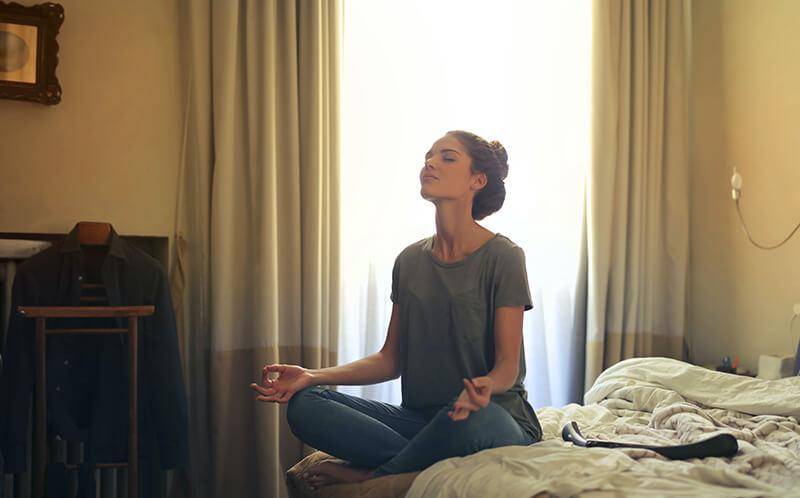
In yoga, movement is connected with breathing. There are many different exercises and approaches, which of course can be practiced not only before bedtime. However, a few simple and short exercises to switch off can easily be done before going to bed.
Sit cross-legged on a yoga mat on the floor or for a short exercise on your bed and let your head hang heavy. Slowly roll your head from the right to the left shoulder and back again. Repeat this several times, paying attention to deep and even breathing. Then circle your shoulders. Light stretching exercises are also helpful to relax the body. For this, inhale and raise both hands above your head, grasp your left wrist with your right hand, and exhale as you pull your arms to the right. Keep your upper body straight. Repeat on the other side.
Then lie down, stretch one leg out long, and pull the other leg bent towards you. You should feel a stretch on the back of the extended leg and in the hip. After a few breaths, switch sides. To finish, lie flat on your back for 1 - 2 minutes, arms and legs relaxed and stretched out. During the yoga exercises, make sure to focus your thoughts on the here and now. Concentrate fully on your breathing and actively feel every movement and stretch.
Unlike a yoga session, you should avoid exercise before falling asleep.
With these five relaxation exercises for falling asleep, you can perfectly prepare yourself for sleep and dive into the beautiful world of dreams. In general, however, a change in sleep habits and diet as well as a healthy lifestyle can have a positive impact on sleep and health. Here you can find more tips and tricks for falling asleep.
About Third of Life
Third of Life is backed by sleep experts with many years of experience who want to help you sleep better. In close collaboration with sleep researchers and based on studies from science and practice, we develop functional sleep products, from nightwear to pillows and duvets to mattress protectors, to improve the special third of our lives: sleep. In our magazine, we also provide helpful tips and recommendations for restful nights.
More on the topic:

How do I find my ideal sleep rhythm?
Sleeping in the Heat - Tips for Summer